









When trust in leadership is falling, organisations don't necessarily need to communicate more. They need a stronger internal communication strategy that helps employees understand decisions, feel included and find the answers they need.
Imagine working for an organisation going through a major change.
You hear about a new strategy in an email. A few days later, your CEO discusses it in a town hall. Your manager mentions it in a team meeting, and another update appears on the intranet.
You've received the message. But do you understand why the change is happening? Do you know what it means for your role? And if you want to revisit the explanation next week, do you know where to find it?
These questions highlight one of the biggest challenges facing internal communications today: the gap between what organisations believe they are communicating and what employees actually experience.
The Growing Trust Gap in Internal Communications
The Institute of Internal Communication's (IoIC) 2026 IC Index, conducted with Ipsos Karian and Box and based on 5,000 UK workers, highlights a growing challenge for employers.
The findings include:
-
Only 50% trust their CEO or most senior leader, a nine-percentage-point fall compared with 2025.
-
Just 49% agree that the reasons behind organisational changes are clearly communicated.
-
Only 42% feel their organisation is good at helping employees adapt to change.
-
Just 49% agree that people can share their opinions at work without fear of negative consequences.
Source : IoIC, IC Index 2026: The Reality Check.
These figures don't mean every organisation has a leadership problem or that communication technology is responsible for declining trust.
Trust is influenced by leadership behaviour, business decisions, workplace culture and employees' everyday experiences.
However, the research raises an important question:
Are organisations giving employees the clarity, context and connection they need to understand what's happening around them?
Challenge 1: Communicating Change Without Explaining Why
Organisations are constantly evolving. Strategies change, technology transforms how people work, structures shift and business expectations increase.
For leaders, the reasons behind these decisions may be obvious. They've spent months reviewing business cases, evaluating options and considering the consequences.
Employees, however, may only see the final announcement.
A restructure is communicated, but the rationale remains unclear. A new technology is introduced, but employees don't understand how it will affect their work. A strategy is presented, but teams struggle to connect it to their day-to-day responsibilities.
When context is missing, uncertainty fills the gap.
Employees naturally look for answers. They ask colleagues, interpret fragments of information and sometimes rely on rumours. This isn't necessarily resistance to change. Often, they're simply trying to make sense of what's happening.
The 2025 IoIC research found that only 51% of UK employees felt their leaders understood the challenges they faced. It also found that 56% felt difficult changes were communicated with care.
Source : IoIC, IC Index 2025.
The lesson for leadership teams is simple: employees don't need every announcement to be perfectly polished. They need communication that feels honest, relevant and human.
How Leadership Video Improves Employee Communication
Written announcements are useful for sharing facts, timelines and actions. But some messages require more context.
A leader explaining a difficult decision in their own words can communicate tone, acknowledge uncertainty and provide reassurance that may be harder to convey through a formal email.
A live town hall gives employees an opportunity to hear directly from leadership and ask questions. A recording allows colleagues who couldn't attend to catch up. Short follow-up videos can address questions that emerge after the initial announcement.
The objective isn't to replace written communication with video.
It's to choose the right format for the message and make it accessible to the people who need it, including remote, hybrid and frontline employees.
Challenge 2: Valuable Internal Communication Gets Lost After It's Shared
Think about the time and effort that goes into a leadership update.
Someone develops the message, prepares the presentation, coordinates the recording, edits the content and publishes it. Senior leaders dedicate time to communicating their priorities.
Then what happens?
The recording sits in a meeting folder. The link gets buried in Microsoft Teams. A colleague remembers watching it but can't recall where it was stored. A new employee joins several weeks later and never sees it.
This is a common challenge for organisations using Microsoft 365 and other collaboration tools.
Content is created across meetings, SharePoint sites, OneDrive folders and communication channels.
The problem isn't necessarily a lack of information. It's knowing where important information lives, whether it's still relevant and how to find it when needed.
A recording can be watched thousands of times and still be difficult to use if employees cannot locate the specific explanation they need.
Turning Internal Video Into Searchable Organisational Knowledge
The value of internal video shouldn't end when the broadcast finishes.
Consider these examples:
-
A manager revisits the CEO's explanation of a strategic change before discussing it with their team.
-
An employee who missed a town hall catches up on important decisions.
-
A new starter finds the original explanation of organisational priorities rather than relying on second-hand information.
-
A team returns to a training video when a process changes or a question arises.
These moments help preserve context, reduce repeated explanations and make organisational knowledge more valuable over time.
The goal is to move beyond one-time video communication and make important information accessible whenever employees need it.

How an Enterprise Video Platform Supports Your Internal Communication Strategy
Most organisations already have technology for meetings, collaboration, document storage and communication.
Microsoft Teams, SharePoint and OneDrive are valuable parts of that environment.
The question isn't necessarily whether to replace these tools. It's whether they provide everything the organisation needs to manage, distribute and make sense of internal video content at scale.
This is where a specialist enterprise video platform like QUMU can help.
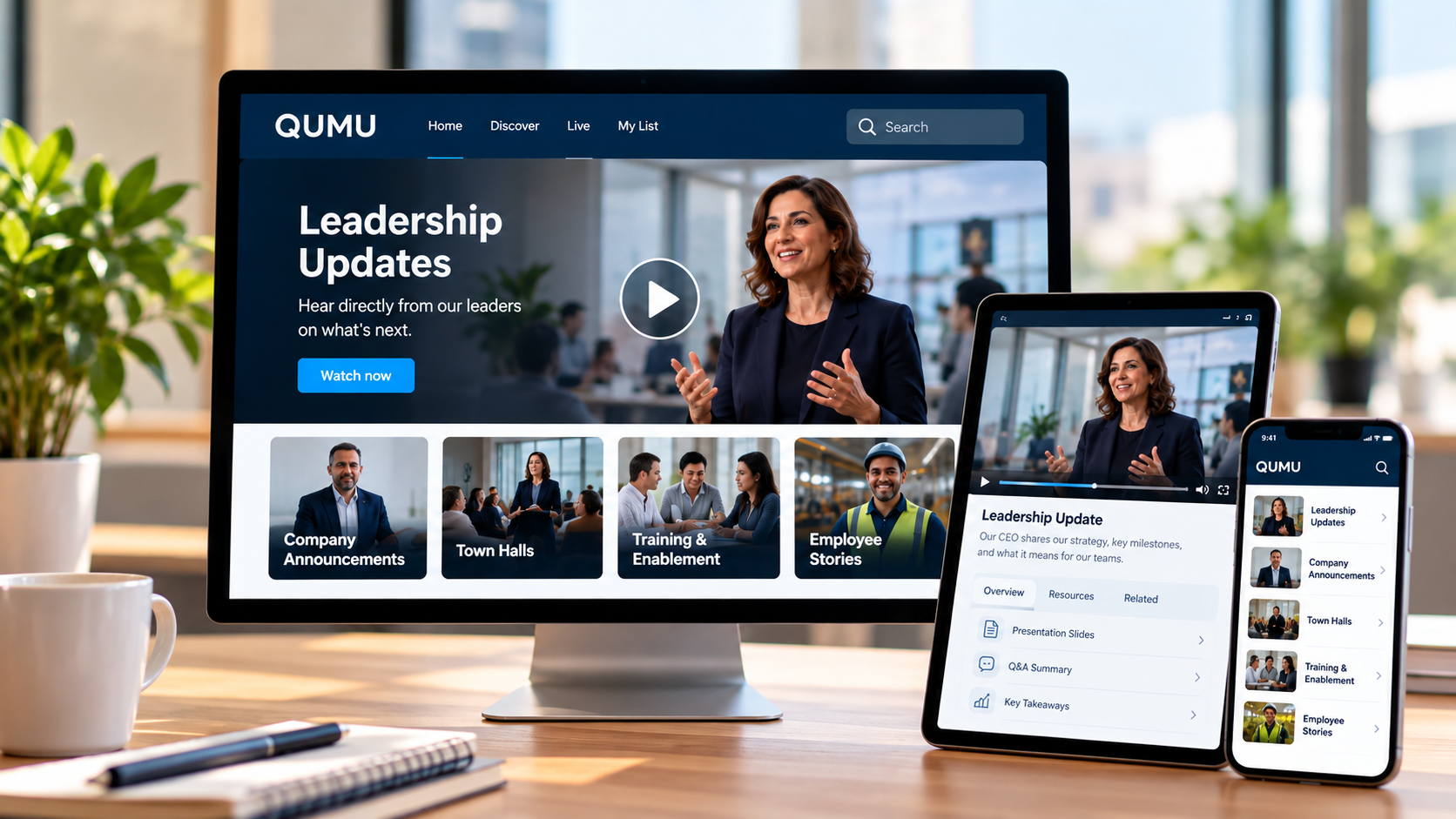
QUMU works alongside Microsoft 365 to provide a dedicated environment for internal video communication, leadership engagement and organisational knowledge sharing.
Depending on an organisation's requirements and configuration, this can include:
1. Centralised Video Communication
Instead of asking employees to navigate multiple folders and disconnected links, organisations can create a central, branded destination for leadership updates, town halls, training and company announcements.
This makes important communication easier to access across departments, locations and employee groups.
2. Searchable Video Content and Knowledge Sharing
A recording shouldn't become difficult to find once a meeting ends.
Video search, organisation and content management capabilities help employees locate relevant information and revisit important explanations when needed.
This can turn internal video libraries into more useful organisational knowledge resources.
3. Secure Enterprise Video Management
Leadership discussions, employee communications and internal training may contain sensitive business information.
Appropriate access permissions, identity controls, retention policies and governance help organisations manage how video content is distributed and accessed.
A dedicated enterprise video platform can support these requirements alongside existing Microsoft 365 security controls.
4. Video Analytics and Employee Engagement Insights
Views and attendance provide useful information, but they don't tell the whole story.
Video analytics can help internal communications teams understand engagement patterns, identify content employees are accessing and determine where additional communication may be needed.
These insights should be combined with employee feedback and measures of understanding rather than treated as proof of trust.
5. A Consistent Employee Communication Experience
Employees shouldn't have to search across multiple systems to understand what's happening in their organisation.
A dedicated video experience can help deliver leadership messages, training and company knowledge more consistently across teams, locations and devices.
Technology alone cannot create trust. But it can remove practical barriers that prevent good communication from reaching employees and remaining useful.
Measuring the Success of Your Internal Communication Strategy
It's tempting to evaluate internal communication by the number of emails opened, recordings watched or employees reached.
Those metrics matter, but they only tell part of the story.
A stronger measurement approach starts with the business problems an organisation is trying to solve.
Ask:
-
Can employees explain the reasons behind a major organisational change?
-
Can frontline employees access the same important information as office-based teams?
-
Can managers find original leadership messages when questions arise?
-
Are communications teams repeatedly recreating content that already exists?
-
Can the organisation demonstrate that essential information is reaching the right employees?
These questions connect internal communication to practical business outcomes.
Better access to existing content may reduce duplication. Reusable leadership explanations can help managers communicate consistently. Clearer messages may help employees navigate organisational change.
Organisations can evaluate progress by measuring:
-
Time spent searching for important information
-
Repeated requests for explanations
-
Access to communication across employee groups
-
Engagement with leadership updates
-
Employee feedback on clarity and understanding
The business case for an enterprise video platform becomes stronger when it addresses identifiable communication challenges and delivers measurable improvements.
Technology Can Support Employee Trust, But Leadership Must Earn It
There's an important difference between communicating at employees and communicating with them.
A video recording can make leadership more visible, but visibility alone doesn't guarantee trust.
A well-designed communication portal cannot compensate for decisions employees perceive as unfair or feedback that goes unanswered.
Trust requires leaders to explain their reasoning, acknowledge difficult realities, listen to concerns and demonstrate what happens as a result of employee feedback.
Internal communications teams play an important role in making that possible.
They help leaders communicate clearly, create opportunities for dialogue, reach different employee groups and ensure important information remains accessible after an announcement.
Technology should support that work, not replace the communication strategy itself. The best outcome isn't that employees watch more videos.
It's that employees feel better informed, understand what's expected of them and can access the information they need without unnecessary friction.
Building an Internal Communication Strategy That Delivers Lasting Value
Before commissioning another leadership video, launching another communication channel or sending another company-wide email, ask three questions:
-
Will this help employees understand something that matters to them?
-
Will they be able to access the information when they need it?
-
Will we know whether the communication made a difference?
If the answer to any of these questions is no, there may be an opportunity to improve how communication is planned, delivered and managed.
For organisations already creating substantial amounts of internal video, QUMU can be part of that approach.
Not because technology can manufacture trust, but because the right infrastructure helps valuable communication become more accessible, consistent and useful over time.
The opportunity isn't to make employees watch more content. It's to make the communication organisations already invest in count for more.
Make Your Internal Video Communication Work Harder
Discover how QUMU helps organisations centralise leadership communications, manage enterprise video securely and make important information easier to find.
 English
 Français
 日本語
 Español
 Italiano
 Nederlands
 Deutsch