







Each year, Global Accessibility Awareness Day (GAAD) serves as an important reminder that accessibility is ultimately about people. Observed on the third Thursday of May each year, GAAD highlights our commitment to ensuring everyone can fully participate in education, healthcare, work, communication, and public life, regardless of disability.
At Enghouse Video, accessibility is not treated as a compliance checkbox, or a “nice to have.” It is a core part of how we design, evaluate, and improve our products. It is why we do testing with real users with disabilities. Accessibility means building experiences that are usable, flexible, and inclusive for everyone from the start.
For us, that means not just reaching compliance, but striving to go above and beyond, to truly help our users have a more inclusive and equitable viewing experience. Yes, that means we support keyboard navigation, screen readers, captions, audio descriptions. But we also support customizable viewing experiences and accessible workflows throughout the video lifecycle. It means listening to users, continuously improving, and recognizing that accessibility is never truly “finished.”
Reflecting on a Year of Progress
Over the past year, our teams at Enghouse Video have continued to make meaningful progress in accessibility across our portfolio. One of the areas I am most proud of has been the collaboration across teams and products. In that time, I have worked with 12 products to help complete accessibility audits, develop VPAT/ACR documentation, identify accessibility gaps, and complete remediation efforts. Those efforts required close partnership between Product Management, Research & Development, UX, QA, and leadership teams, all working toward the shared goal of creating more accessible experiences for our users.
We also expanded our accessibility education efforts through webinars focused on the new legal requirements from EAA, Title II, and Section 504 updates. We welcomed Kris Rivenburgh, an attorney and accessibility expert, as well as Dr. Nicole Johnson, a digital education specialist, to discuss the evolving accessibility regulations, practical remediation strategies, and how organizations can create more inclusive digital learning and communication experiences. Accessibility awareness is important, but accessibility action is what truly creates change.
Accessibility Highlights Across Our Portfolio
This year also brought several accessibility-focused product advancements across the Enghouse Video portfolio.
Mediasite Accessibility Dashboard
One of the most significant launches was the new Accessibility Dashboard in Mediasite. While platform accessibility remains critically important, organizations are increasingly being asked to evaluate the accessibility of their content itself.
The Accessibility Dashboard helps organizations better understand the accessibility posture of their video libraries by surfacing actionable insights around captions, audio descriptions, and accessibility-related metadata. The goal is not simply to identify problems, but to help organizations continuously improve accessibility across their content ecosystem.
Qumu Caption Customization Improvements
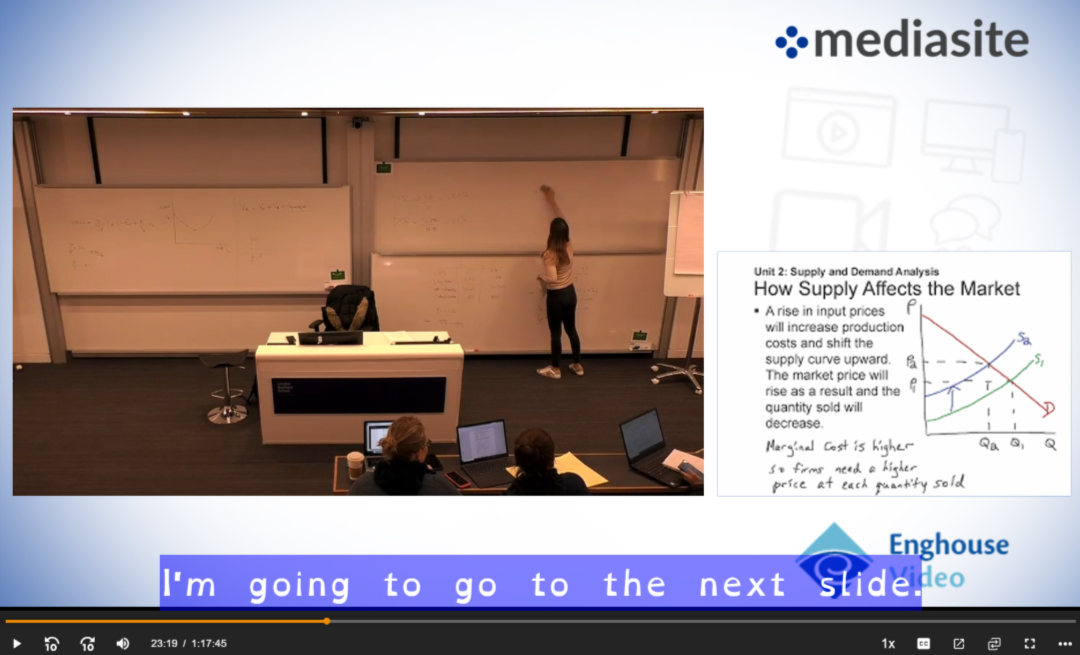
We also continued improving accessibility within Qumu; including the addition of user-controllable caption settings such as font customization, text color, background color, and other display controls; as well as support for multiple audio tracks, allowing for multiple audio languages to be offered during playback.
Accessibility is not one-size-fits-all. Giving users control over how they consume content can dramatically improve readability and usability for people with diverse visual, cognitive, and learning needs.
Accessibility is More than Compliance
Compliance standards matter. Regulations such as ADA Title II, Section 504/508, EN 301 549, EAA, the Equality Act of 2010, and more help establish important accountability and expectations for digital accessibility. But accessibility cannot only exist because regulations require it, and accessibility does not end when compliance standards are met.
True accessibility work starts with recognizing that inaccessible technology creates real barriers for real people. When a video lacks captions, when a player can’t be navigated with a keyboard, when content is unreadable for someone with low vision, users are excluded from information and experiences others may take for granted.
Accessibility done well is not about passing an audit avoiding litigation. It is about dignity, independence, including, and equal access. That is why Enghouse Video continues to invest in novel ways of going above and beyond legal standards to make our products more accessible to everyone.
Accessibility Delayed is Still Accessibility Denied
However, progress alone is not enough, and there is an important reality that cannot be ignored. I would be dishonest if I said I was not disappointed to see accessibility compliance deadlines, including ADA Title II and HHS updates to Section 504, pushed back in the United States this year.
People with disabilities do not get to postpone needing access to education, healthcare, public information, or workplace communication for another year. Accessibility barriers exist here and now, today. That is why delays to accessibility enforcement timelines are frustrating to those of us who work in this space every day.
For organizations already prioritizing accessibility, these delays may not significantly change their direction. But for organizations waiting until the final possible moment to act, extensions risk becoming another reason to postpone work that users need today.
Accessibility can’t continue to be treated as a future initiative or a compliance project to address later. The need for accessible digital experiences already exists, and for many users, delays in accessibility directly impact their ability to participate fully in society.
Organizations should not view these extensions as permission to wait. The organizations making the most meaningful progress today are the ones treating accessibility as a strategic priority now, not as a deadline-driven exercise for later.
Accessibility Cannot Wait
One of the most encouraging parts of this work is seeing the organizations that are embracing accessibility, not because they are forced to, but because they recognize it as the right thing to do.
A strong example of this is the work being done by the University of Bristol, which has been widely recognized for its leadership in digital accessibility and inclusive education practices. Their efforts demonstrate what is possible when accessibility becomes part of organizational culture, instead of simply a compliance exercise.
That mindset is what we hope to continue supporting through our products, partnerships, and ongoing accessibility investments.

Looking Forward
Global Accessibility Awareness Day is an opportunity to reflect on how far we’ve come, but also how much work remains.
At Enghouse Video, we remain deeply committed to continuing this work across our portfolio. We will continue to conduct audits, remediate gaps, educate customers, design accessible products, and keep innovating to help organizations create more inclusive video experiences.
Some of the areas we are investing in are focused on providing more cost effective solutions for Audio Description tracks, supporting the use of the ColorADD system to identify colors to colorblind users, using Artificial Intelligence to conduct deep scanning for accessibility issues in video, supporting sign language translation alongside video, and moving towards WCAG AAA level compliance. Along the way, we will continue to provide strategic guidance to our customers through continued conversation. We see the way accessibility requirements are continuing to grow, and are working to future-proof our products and services to help all our users.
Accessibility is not a trend, and it is not temporary. It is a long-term responsibility.
Accessibility is not optional, and it cannot wait.
We encourage organizations not to wait for the next deadline to prioritize accessibility. Start the conversations now, evaluate your current experiences, and make accessibility part of your long-term strategy.
Click here to learn more about Enghouse Video’s accessibility initiatives and accessibility-focused product capabilities.
 English
  Français
  日本語
日本語  Español
  Italiano
  Nederlands
  Deutsch